Waste is seen as an inevitable output of our economy. But it’s better understood as a symptom of problems with the way we use materials and energy to meet our wants and needs.
There’s a critical imbalance. On one side we have powerful supply chains pumping out all our stuff. On the other, weak recovery chains. These, in theory, should gather it all back up and send it around again for reuse, repair, remanufacture, or to become recycled content in new products or compost for our soils. The companies that make products and materials have no obligation to consider what will happen at the end of their (often too short) life.
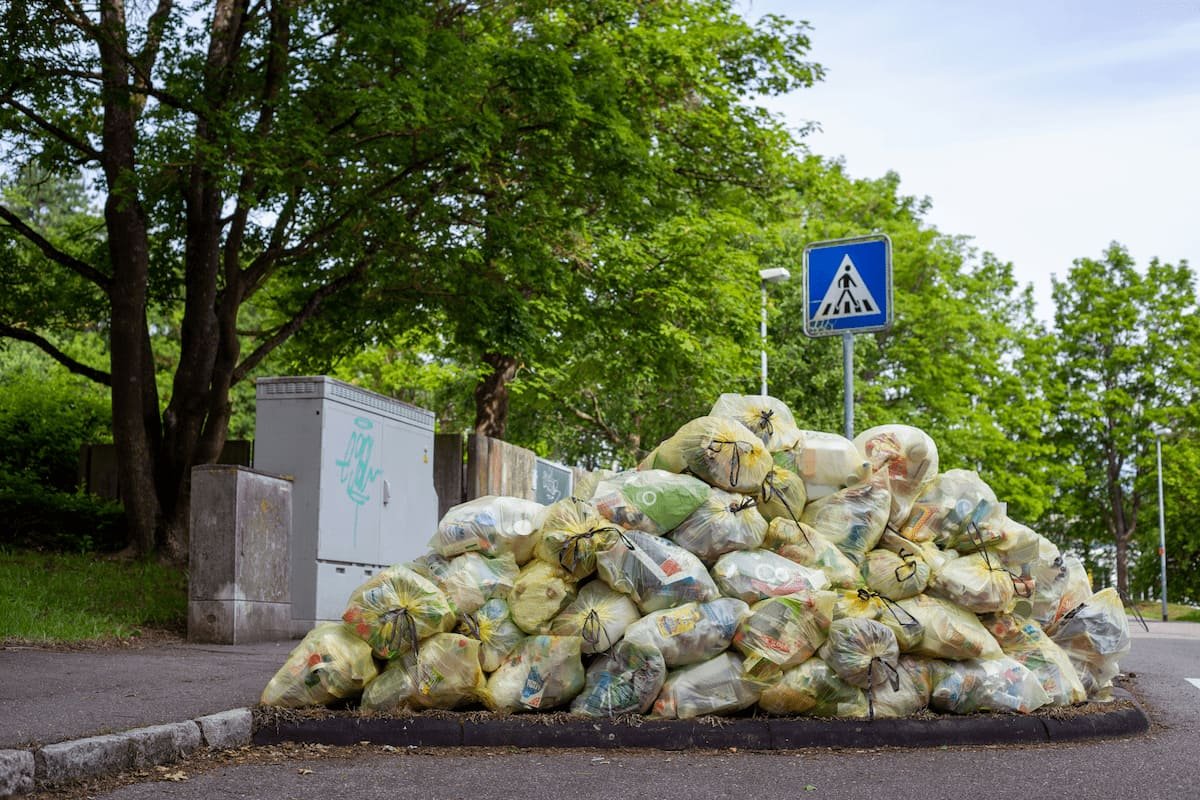
So far, the central and local government have focused on managing our waste problems, rather than solving them. Much of the investment has been channelled into creating systems for collecting, transporting and storing domestic and commercial rubbish in landfills.
Recycling is a popular activity. But the methods used for some collection systems deliver low quality materials. They don’t meet the specifications of reprocessors or export markets.
Our extractive linear economy comes at a big cost. And a circular economy is still a hazy future vision. Circle Economy uses data to create global and regional circularity indexes. It calculates the global economy to be 6.9% circular (revised – 2025 stat). Sadly, that makes us 93.1% linear. AND we’re heading in the wrong direction – we were 9.1% circular only a few years ago.
Environmental Impact
The limits to this extractive, linear approach are becoming obvious. The economic value of ecosystem services is estimated to be 1.5 x global GDP. Meanwhile, 90%+ of biodiversity loss and water stress is caused by extraction, pollution and wasteful use of resources.
The way we produce, consume and dispose of products, materials and energy creates negative impacts: habitat destruction, biodiversity loss, resource depletion, air, water and land pollution and topsoil loss. All this on top of the long term costs and risks of waste disposal.
It’s too depressing to list all the data we already have on the ways we’re overshooting planetary boundaries, but the massive increase in raw materials we’ve pulled into our economy over the last 50 years puts our problems into perspective.
The global population has doubled since 1970, but our resource use has quadrupled. We used 26.7 billion tonnes of raw materials in 1970 to provide goods and services to the 3.7 billion people alive back then. In 2020, we extracted 100+ billion tonnes. No wonder we’re in the midst of the sixth mass extinction.
Climate change adaptation and mitigation
At the same time as we burn through our capital stocks in the natural world, our addiction to cheap fossil fuel energy is warming up our planet. Recent United Nations Climate Change Conferences have shown us that the climate promises contained in Nationally Determined Contributions don’t come close to keeping us within 1.5 degrees of warming.
Three main types of emissions are generated from the ‘waste’ our economy creates as a side effect of production and consumption systems.
- Emissions from landfill: mainly biogenic methane from organics stored in landfills
- Consumption-based emissions: greenhouse gases generated across the product life cycle (mainly CO2 and N2O) – these cut across sectoral silos (carbon footprint)
- F-Gases: HFCs escaping to the atmosphere from products eg. air conditioning units
Biogenic methane emissions show up in production-based emissions accounting. This is the main component of the 4% of GHG emissions the waste sector contributes to New Zealand’s emissions profile.
The long-lived consumption-based emissions generated upstream from extraction, production, transport retail, use and resource recovery of packaging, and all our other stuff, show up in carbon footprinting analysis.
About 42% of all USA GHG emissions are created in the process of extracting resources, producing goods, disposing of waste, transporting materials and so on. Globally, this figure is estimated at around 45% of total emissions, though this half of the pie chart is frequently overlooked by emissions accounting systems.
Image taken from Ellen MacArthur Foundation (2019) Completing the Picture: How the Circular Economy Tackles Climate Change, p.13.
Reducing these consumption-related emissions should be top of the waste and climate policy list. They account for 10 times more emissions than the 4% of methane emissions from landfill that we’re currently obsessing over.
Given that the recent Intergovernmental Panel on Climate Change (IPCC) report data provoked the United Nations Secretary-General to declare “a code red for humanity” we need to pull every lever we can reach to decarbonise our economy.
Social impact
The social impacts of growing up in a consumer culture are weighing people down. They’re affecting our mental health, our social connections and our relationships with the places we inhabit and the creatures we share them with. Our consumption-driven economy depends on leaving us unsatisfied, so we keep coming back for more. But having more and feeling better are no longer connected for many people.
People are confused and frustrated. We receive so many mixed messages it’s no wonder our mental health stats are racing up the scale. On the one hand, being a good consumer and a good citizen have become synonymous; we get told to ‘BUY BUY BUY – shopping will save our economy!’ On the other hand, we must take responsibility for solving the economy’s waste problems by choosing wisely and putting all those short-life goods and non-recyclable packaging into the right bin to save our planet.
Our society is deeply unequal. Economic costs and benefits are unevenly spread. Questions of distribution (access to goods, services, healthy food and opportunities for a decent life) are as relevant within Aotearoa as they are globally.
“In many parts of the world, linear over-consumption has effectively become the norm, whilst elsewhere, minimum living standards are not even being reached.”
Affluence and income are strongly correlated to environmental impact. Forty-eight percent of cumulative CO2 emissions in the last 25 years belong to the richest 10% of the globe, with the poorest 50% only responsible for 7%.
If we’re serious about reducing our collective consumption and emissions footprint, we need deep and real engagement with communities to ensure we take everyone along with us. Furthermore, one solution does not fit all. For some of us, the best answer is reduction – having and using less. For others the solution is having access to and using more.
Taking responsibility is about much more than picking up litter and putting the right thing in the right bin. To ensure an equitable transition, the Government must invest in practical, local, community-scale solutions. This applies to behaviour change work as well. Wellbeing and resilience should be built into the heart of our economy.
References
- Haigh, L., de Wit, M., von Daniels, C., Colloricchio, A. and Hoogzaad, J. (2021) The Circularity Gap Report (Amsterdam: Circle Economy) https://www.circularity-gap.world/2021, p 20-21.
- Images from Bradford, A. Broude, S. and Truelove, A. ( Feb 2018). Trash in America: Moving from destructive consumption to a zero waste system. U.S. PIRG Education Fund, Frontier Group, Toxics Action Center, https://uspirgedfund.org/reports/usf/trash-america
- Costanza, R., et al. (May 2014). ‘Changes in the global value of ecosystem services’. Global Environmental
- Change, Volume 26, pp.152–158; Kirth, T. et al. (Mar 2021). The Biodiversity Crisis is a Business Crisis. Boston Consulting Group, https://www.bcg.com/publications/2021/biodiversity-loss-business-implications-responses; Organisation for Economic Co-operation and Development (2019). Biodiversity: finance and the economic and business case for action, cited in Ellen MacArthur Foundation (2021). The Nature Imperative: How the circular economy tackles biodiversity loss. Retrieved from https://ellenmacarthurfoundation.org/biodiversity-report
- Ellen MacArthur Foundation (2021). The Nature Imperative. How the Circular Economy tackles biodiversity loss. https://ellenmacarthurfoundation.org/biodiversity-report, p.11.
- Circle Economy (2020). Circularity Gap Report 2020. https://www.circle-economy.com/resources/circularity-gap-report-2020
- Ellen MacArthur Foundation (2021). The Nature Imperative. How the Circular Economy tackles biodiversity loss. https://ellenmacarthurfoundation.org/biodiversity-report
- Zero Waste Scotland (2021). Everything We Buy Has a Carbon Cost. https://zerowastescotland.org.uk/content/everything-we-buy-has-carbon-cost
- U.S. EPA (March 2015), Documentation for Greenhouse Gas Emission and Energy Factors Used in the Waste Reduction Model (WARM). Office of Resource Conservation and Recovery. https://archive.epa.gov/epawaste/conserve/tools/warm/pdfs/WARM_Documentation.pdf
- Ellen MacArthur Foundation (2019) Completing the Picture: How the Circular Economy Tackles Climate Change. www.ellenmacarthurfoundation.org/assets/downloads/Completing_The_Picture_How_The_Circular_Economy-_Tackles_Climate_Change_V3_26_September.pdf.
- UNEP (Oct 2021). The Heat is On: A world of climate promises not yet delivered. Emissions Gap Report 2021, https://www.unep.org/resources/emissions-gap-report-2021, p xvi.
- See Tim Jackson (2015) Prosperity without growth Foundations for the economy of tomorrow second edition – chapter 6 on the Iron cage of consumerism. (accessed from Kindle edition)
- Tim Jackson (2021) Post growth : Life after capitalism (accessed via Kindle edition)
- Max Rashbrooke (2021) Too Much Money: How wealth disparities are unbalancing Aotearoa New Zealand (Bridget Williams Books).
- Haigh, L., de Wit, M., von Daniels, C., Colloricchio, A. and Hoogzaad, J. (2021) The Circularity Gap Report (Amsterdam: Circle Economy) https://www.circularity-gap.world/2021, p.12.
- Wiedmann, T. et. al (June 2020). ‘Scientists’ warning on affluence’. Nature Communications, Vol. 11, Article no. 3107. https://www.nature.com/articles/s41467-020-16941-y