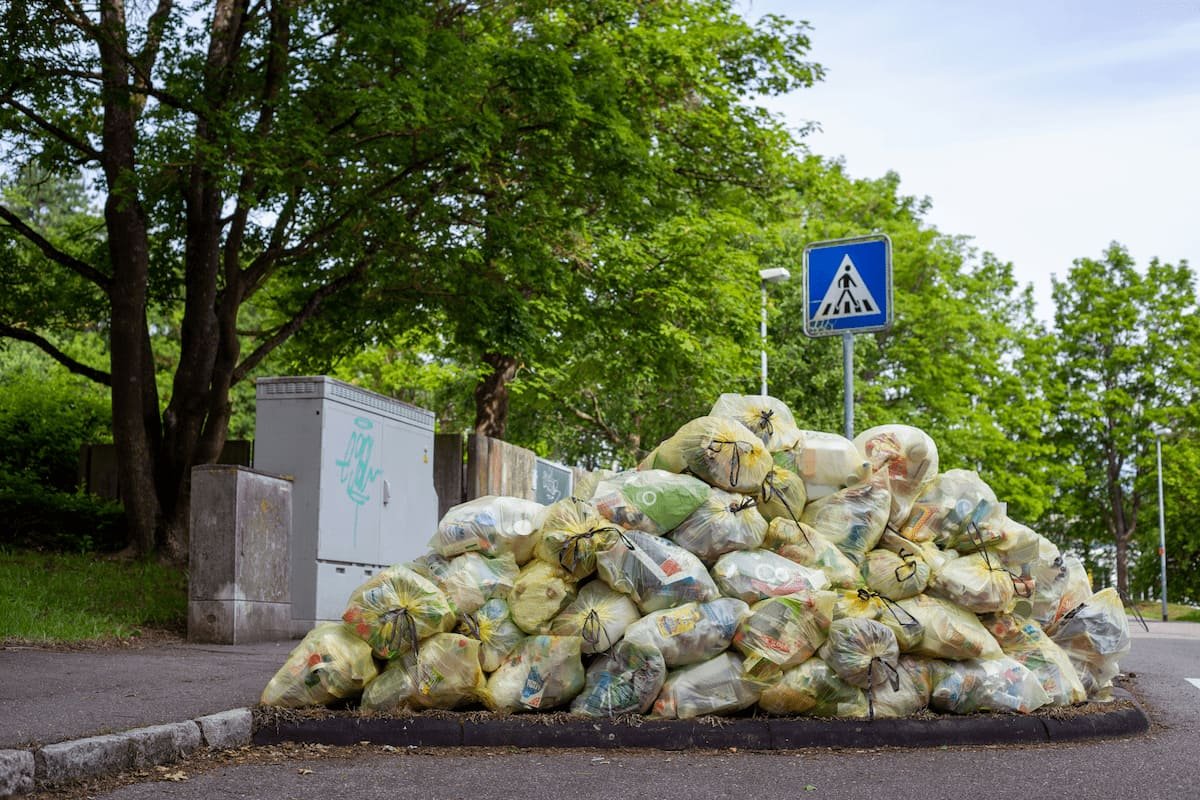
New Zealand is falling further and further behind every year. We’re stuck in a mind numbing loop, talking about whether we should burn or bury all our rubbish. All this conversation does is keep us staring in the wrong direction. It stops us seeing the massive elephant here in the room with us.
Where do all the resources come from in the first place?
When we turn and look upstream, we see that every time we burn or bury products and packaging, we have to go back to our environment and pull new resources and energy into our economy, to make more stuff, to fill the gap.
Unnecessary extraction and production changes land use, damages ecosystems and pollutes air, land and water. We lose habitats, biodiversity, forests that used to absorb CO2, and our health. It pumps out greenhouse gases causing global warming and climate change.
Our global resource use is speeding up fast. When I was a kid in the 1970s we pulled 25 billion tonnes of resources out of our environment into the global economy every year. 50 years later, it’s 100 billion tonnes. In the last six years we’ve consumed pretty much the same amount of resources as the world did in the whole of the 20th century.
Connecting the dots
Connecting the dots between rubbish, pollution and our production and consumption system is very useful. It shows us what we need to do to make the transition. Circular economy thinking and the Zero Waste Hierarchy both tell us the same story.
The only way to solve our waste and pollution problems is to go up the supply chain. To change business models and redesign products. To keep products and materials in circulation for as long as possible and to use processes that regenerate natural systems.
Companies that make products and packaging and put them into the market don’t always have to take responsibility for their negative impacts. We call these “externalities”, because they’re not built into the business models and therefore have no impact on these companies’ balance sheets.
Dealing with the impacts – recycling, litter and pollution, clean ups and rubbish disposal, usually get covered by ratepayers and taxpayers.
Society and our environment bear the costs, risks and liabilities created by businesses putting poorly designed, short life, disposable and sometimes toxic, products and packaging out onto the market.
Companies are not required to put systems in place to manage impacts across the life cycle, take them back at the end of their lives or to drive improvements in product or service design.
This connection between waste, pollution and business models gets pushed out of sight.
Disconnecting them makes waste and pollution feel inevitable or accidental rather than the result of deliberate business decisions.
It creates the illusion that we can’t really do anything about it. It avoids any awkward questions about who’s really responsible and should therefore have to pay.
Packages of tools and levers
Governments around the world use packages of regulatory tools and levers to shape the responsibilities and price structures of businesses. The goal is to reduce the costs, risks and liabilities imposed onto society and our environment.
This puts money into the system to cover the operational and capital costs of establishing and running reuse and recycling systems. It puts drivers in place to reduce the amount of waste, pollution and recycling we need to deal with in the medium to long term.
Two handy tools in our toolkit
The idea of building up a pool of capital that’s ring-fenced for establishing and maintaining a set of public assets makes a lot of sense.
That’s exactly what our Waste Disposal Levy is. It puts a charge on what we don’t want – rubbish – to give us a pool of capital to pay for what we do want – effective reuse and recycling systems.
The Waste Levy was ring-fenced. It had to be spent on waste minimisation. This justified the charge and created a theory of change: as waste reduction infrastructure and systems were established, waste would reduce over time.
Alongside that, we have Product Stewardship – which has two critical components:
- Economic instruments, like producer fees, can be used to create the revenue streams we need to establish, operate, maintain and improve reuse and recycling systems.
- Product Stewardship schemes provide the organising framework and the network of relationships and services needed to make all that happen.
So how might that play out in the real world?
It’s reasonable to expect that the costs associated with collecting and recycling single use drink bottles, cans and cartons should fall on those that benefit from the sale of the product – that’s the producer and the consumer.
So we could establish a deposit return scheme to collect and recycle 90% of drink containers and supply good quality raw materials to manufacturers to add as recycled content to their next round of packaging.
Our container deposit return scheme would:
- Set clear rules about who pays and oblige every company that puts that product onto the market to contribute their fair share towards dealing with the problem their business model has created.
- Make someone responsible for getting the job done by establishing an agency to put the infrastructure, systems and processes in place to achieve the goals and targets.
- Give people a good reason to do the right thing by charging consumers a deposit when they buy a drink that they get back when they drop their empties off at a convenient drop off point.
- Cover the full net cost, so that every container that comes onto the market pays its own way through the recycling system. Drop off points would get a handling fee that covers the real cost of running, maintaining and improving the collection and sorting system.
- The Waste levy helps by kickstarting the new infrastructure required to radically reduce the impact of drink containers like collection systems and wash plants for reusables.
So what’s blocking our shift to a zero waste, circular economy?
We know what the real problem is
We know what a good plan looks like
We have the tools to get the job done
So how come it’s so hard for our Government to create the pipeline of projects that would shift us up the waste hierarchy and solve our waste problems for once and for all?
The challenge comes from ‘upstream’, where business profitability often depends on being able to pump out cheap, junk products and packaging without having to take any responsibility for the impacts across the lifecycle.
And from ‘downstream’, where the viability of waste companies depends on having a steady stream of rubbish to collect, handle and transport to their landfills.
Zero waste and circular economy strategies provide us with a roadmap, a toolkit and a destination. The reason we face such fierce opposition is because they pose a real challenge to the status quo.